
UK oral cancer incidence has been increasing for more than a decade.
Despite this, the majority of cases are still detected at a late stage. Late-stage diagnosis remains the single most significant determinant of survival outcome.
Visual examination is, and will remain, the key to oral cancer screening in dental practice. But visual examination alone has well-documented limitations. New chairside diagnostic technologies are changing the way frontline dental teams handle suspicious or ambiguous findings.
This article discusses what salivary biomarker testing actually does, where it fits in the clinical workflow, and what practices should consider before implementing it.
To be clear from the outset: this is not a replacement for visual examination. It is a clinical decision support tool that adds objective molecular data to the clinical picture. How regularly a practice uses it is a clinical decision: some will reserve it for suspicious or ambiguous findings, while others will screen higher-risk groups routinely.
The Current State of UK Oral Cancer Detection
Oral cancer is among the most preventable cancers when identified early, yet the UK’s detection record remains poor. According to the Oral Health Foundation’s State of Mouth Cancer UK Report, more than 8,800 new cases of oral cancer were diagnosed in the UK in 2021, which is an increase of 34% over the previous decade.
It’s more than double the number recorded twenty years earlier. By 2024, the Oral Health Foundation reported that UK cases had surpassed 10,000 for the first time.
The consequences of late detection are severe. Cancer Research UK’s survival data shows five-year survival exceeding 85% at stage I, falling to just 35% at stage IV. The survival difference between early and late presentation is one of the most pronounced in oncology. The Mouth Cancer Foundation reports that mouth cancer now causes more deaths in the UK each year than cervical and testicular cancer combined, accounting for over 3,600 lives lost annually.
Dental teams are crucial in this scenario. Most patients see their dentist more frequently than their GP, and the oral cavity is directly accessible during routine examinations.
Yet the referral-to-diagnosis pathway remains imperfect, partly because visual examination (for all its value) introduces variability that clinical training alone cannot fully resolve.
Where Visual Examination Has Limits
Visual and tactile examination of the oral mucosa is the standard of care, and nothing in this article argues otherwise. Experienced clinicians perform it well, and it accurately detects the majority of clinically evident lesions. The question is what happens at the margins, and the margins matter.
The Problem of Subtle and Early-Stage Lesions
Subtle early lesions may appear as unremarkable mucosal changes. A small area of erythroplakia or a mildly irregular white patch may look similar to trauma, ulceration from a denture, or simple irritation. In the absence of a clear visual alarm sign, clinical judgement is left to carry a significant diagnostic burden.
Certain anatomical sites compound this further: the posterior tongue, floor of the mouth, soft palate, and oropharynx are all areas where early lesions can be difficult to visualise completely, especially in patients with a strong gag reflex or limited mouth opening.
Variability Between Practitioners
There is also the inherent subjectivity of clinical interpretation. Research published in peer-reviewed literature has found significant variation between general dental practitioners and specialists in correctly identifying potentially malignant oral disorders, with awareness and diagnostic accuracy consistently lower among GDPs than among specialists.
This is not a criticism of the profession; it reflects the diagnostic complexity of early-stage oral mucosal disease. Adjunctive testing exists precisely to provide objective data where subjective interpretation reaches its limits.
How Salivary Biomarker Testing Works
The biological basis for salivary biomarker testing is well established. When oral mucosal cells undergo malignant transformation, certain protein-based markers become overexpressed and detectable in saliva. The BeVigilant™ OraFusion™ system targets two of these: p16 and EGFR.
p16 (CDKN2A) is a tumour suppressor protein that regulates the cell cycle, and altered expression is associated with dysplastic and malignant oral epithelial change.
EGFR (epidermal growth factor receptor) is a cell surface protein whose overexpression is linked to tumour development and progression in oral squamous cell carcinoma. Measuring both markers together provides complementary signals of abnormal cellular activity rather than relying on a single biomarker in isolation.
The Chairside Process
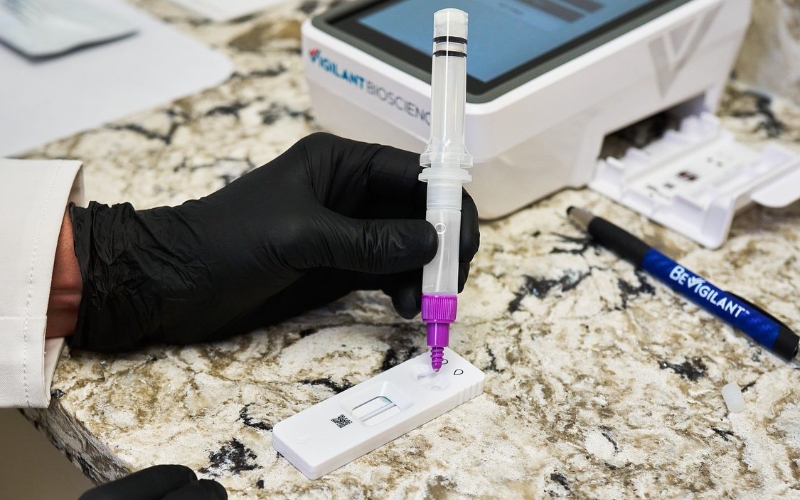
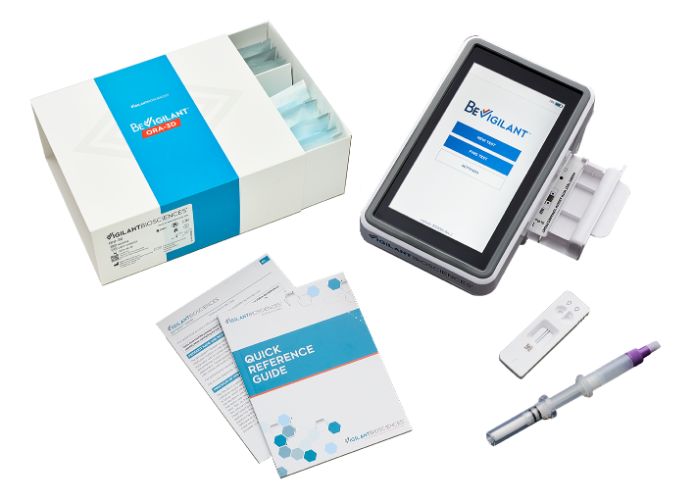
A small saliva sample is collected using the single-use Ora-3D collection device, which requires no needles and no tissue disruption. The sample is applied to the Ora-3D test cassette and inserted into the BeVigilant Reader, which uses a lateral flow immunoassay to generate quantitative biomarker signal intensities.
These are combined with the patient’s clinical risk profile (age, sex, tobacco use, alcohol use, and lesion features) using a unique sensor fusion algorithm. The system has been shown to achieve over 93% accuracy in detecting these biomarkers.
The output, delivered in roughly 15 minutes, is a binary classification: Monitor or Investigate Further. OraFusion is a pre-diagnostic risk stratification tool, not a diagnostic test. A result of “Investigate Further” indicates that the combination of biomarker data and clinical risk factors warrants specialist referral and further evaluation, including biopsy where necessary. It adds objective molecular data to the existing clinical picture; it does not replace it.
Where it Fits in Clinical Workflow
OraFusion is appropriate when visual examination yields a suspicious or ambiguous finding, and the clinician wants objective data to support a referral decision. This is the primary use case, where clinical uncertainty is highest, and the benefit of additional data is greatest.
It is also appropriate for higher-risk patients presenting for routine examination: those who are or have been heavy smokers, consume alcohol heavily, have a history of HPV exposure, or have previously been treated for oral cancer. As the recognised risk-factor profile continues to broaden, some practices will choose to screen defined cohorts on a regular basis, for example, patients over a certain age or those with known lifestyle risk, rather than testing only in response to a specific finding.
It is also suitable when a borderline lesion makes it difficult to decide between “watch and wait” and “refer now.” An objective result can provide a clear clinical rationale for the chosen pathway.
Where it May Not Be Appropriate
OraFusion is not a substitute for visual examination, nor a means of avoiding specialist referral, and a positive result still requires that pathway. The system generates data that the clinician integrates with all of the other information they have about the patient. How regularly a practice screens, and which patient groups it screens, are clinical decisions; what matters is that the result informs the pathway rather than replacing clinical judgement.
There are also specific contraindications to testing: patients with an active oral infection, significant oral bleeding, or recent oral surgery within the preceding ten days are not suitable candidates, as these factors can affect the reliability of results. Patients should also be advised to have nothing by mouth for one hour before the test, including water, food, coffee, and tea. This is most practically communicated at the point of booking or in the pre-appointment reminder.
Professor Bob Khanna’s webinar on rapid chairside oral cancer screening covers the clinical application of OraFusion in considerable practical detail, including how the system integrates with appointment workflows and how to approach patient communication. For dental teams considering whether and how to implement the technology, it is the most useful single resource available.
Regulatory Status and Clinical Evidence
OraFusion carries CE marking and received IVDR approval in September 2025. In the United States, it holds an FDA Breakthrough Device designation, awarded in April 2023. This is a programme designed to expedite the development and review of devices intended to provide more effective diagnosis or treatment of life-threatening conditions than currently available alternatives.
The system is in clinical use across the UK, Germany, Italy, and other European markets. A pivotal multi-site clinical trial is in progress with FDA alignment confirmed as of September 2025.
Practical Considerations for the Practice
Patient communication requires the most care. Introducing biomarker testing to a patient with an uncertain finding means framing it clearly: this is a structured step to determine the most appropriate next action, not a test that confirms cancer. Practices that establish consistent communication protocols for this will see better clinical and patient experience outcomes.
Workflow and Training
Workflow integration is straightforward. The 15-minute test runs alongside other appointment activity with no external laboratory required, which makes it ideal for clinics that already have tight deadlines for urgent referrals.
The device guides the operator through the process at each step, making it straightforward to delegate to a dental nurse, hygienist, or therapist. Practices should ensure that whoever is performing the test is clear on the contraindications and pre-test patient preparation requirements to avoid unreliable results.
Offering a structured oral cancer risk assessment service has significant reputational value for practices that focus on cancer detection and prevention. Unlike many practice differentiators, this one has clinical substance behind it.
Conclusion
The dental teams that use OraFusion effectively are those who treat it as a considered input in a clinical decision-making process, deploying it in the right cases and interpreting it alongside everything else known about the patient.
Oral cancer survival is heavily determined by stage at diagnosis. For practices considering whether adjunctive salivary biomarker testing belongs in their toolkit, the clinical case for earlier, more confident detection is clear. The question is how to integrate it in a genuinely beneficial way rather than simply procedurally.
For technical details on the BeVigilant™ OraFusion™ system, visit the OraFusion product page. For a more in-depth clinical explanation, Professor Bob Khanna’s webinar is the recommended next step. To explore whether OraFusion is right for your practice, get in touch with AMP to arrange a demonstration.
Get in Touch