
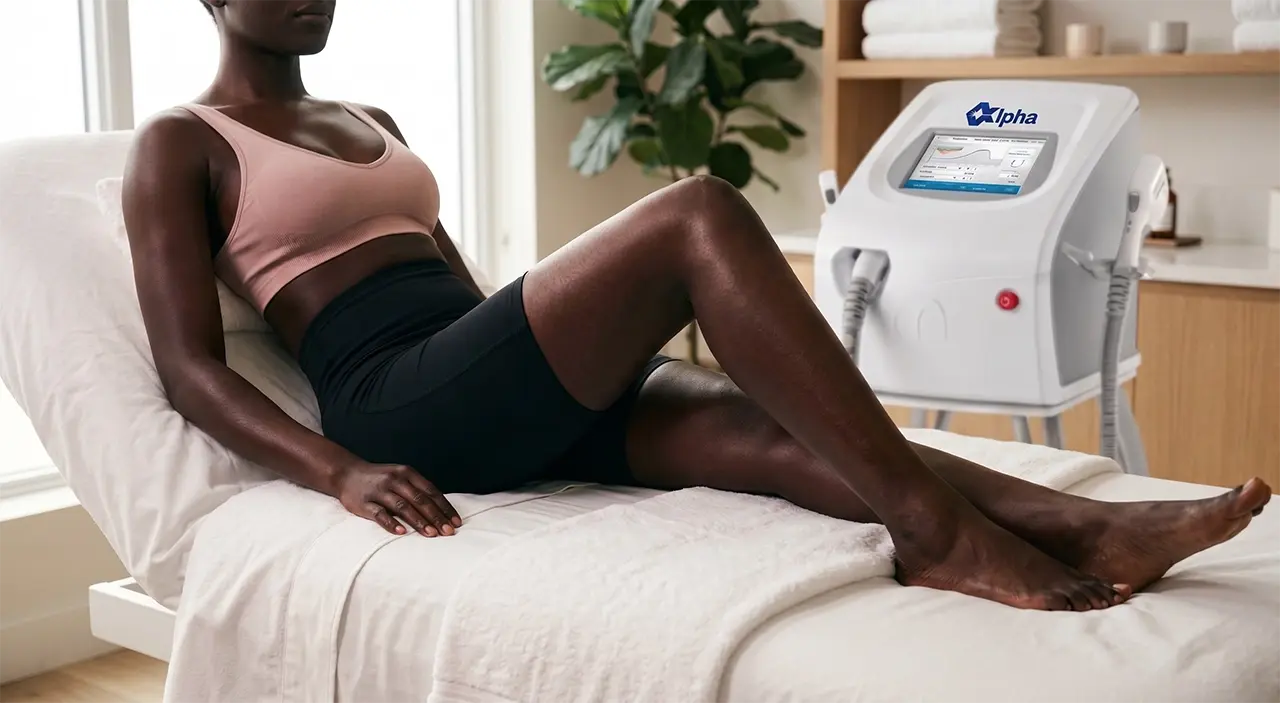
Demand for energy-based treatments spans every skin type, and patients with darker skin are a significant part of any clinic’s book.
But the same device that performs predictably on lighter skin can behave very differently on Fitzpatrick IV to VI. Treating darker skin well is not about doing less; it is about doing it differently, with a clear understanding of the underlying physics and a disciplined, evidence-led approach.
This guide sets out the principles practitioners need to select devices and wavelengths confidently, and to raise the standard of care for every patient who walks through the door.
Why Darker Skin Needs a Different Approach
The defining feature of darker skin, clinically, is increased epidermal melanin, alongside more reactive melanocytes and fibroblasts. For energy-based devices, melanin is a competing chromophore: it absorbs light and laser energy that is intended for another target, such as the hair follicle, a vascular lesion or water in the dermis. When that absorbed energy is concentrated in the epidermis, it generates unwanted heat where you least want it.
The clinical consequences are well documented. Compared with lighter skin, darker skin carries a greater risk of dyspigmentation and scarring, and individuals with Fitzpatrick IV to VI are more prone to prolonged erythema, pigmentary change and scarring following treatment. Post-inflammatory hyperpigmentation (PIH) is the complication practitioners encounter most, and it can be slow to resolve and distressing for patients.
It is worth distinguishing epidermal PIH, which is more superficial and generally more responsive, from dermal pigment, which sits deeper and clears more slowly. This distinction should inform both the modality you choose and the timeline you discuss with the patient.
None of this contraindicates treatment. It simply means device selection, parameters and protocol all have to work harder to protect the epidermis.
Assessing the Patient: Fitzpatrick and Beyond
Patient selection is your first and most important safety control. The Fitzpatrick scale remains the standard starting point, but treat it as a starting point rather than a full picture. It relies partly on self-reported burning and tanning history; it can under-classify constitutive pigment in some patients, and a recent tan can shift facultative melanin well above someone’s baseline. Objective skin-typing tools, including melanin-reading diagnostics built into modern platforms, can support a more reliable assessment and remove some of the guesswork.
A thorough history matters as much as the type itself. Ask specifically about previous PIH or a tendency to mark after minor trauma, any history of keloid or hypertrophic scarring, recent or planned sun exposure, and photosensitising medication.
Establish what the patient has had done before and how their skin responded. Set expectations early: for darker skin, conservative, staged treatment is typically the safest route to a good result, and that conversation is easier before the first session than after a complication.
Principles of Wavelength and Device Selection
The governing principle is straightforward. Longer wavelengths penetrate more deeply and are less readily absorbed by epidermal melanin, so they tend to spare the epidermis. This is why the long-pulsed 1064nm Nd:YAG is widely regarded as the gold standard for laser hair removal in darker skin. At the other end of the scale, fully ablative resurfacing is generally avoided in darker skin because of the pigmentary risk, while non-ablative modalities are preferred for their faster recovery and lower adverse-event profile.
Non-ablative fractional resurfacing is one area where the evidence has matured considerably. The wavelengths used by MultiFrax (1550nm erbium glass and 1927nm thulium) are precisely those studied most in darker skin.
A 2026 review of the dual 1550nm/1927nm fractional system in skin of colour (Fitzpatrick III to VI) reported consistent improvement across studies, though PIH rates varied between them. The wider evidence base consistently links lower energy and density, fewer passes and integrated cooling to a reduced risk of PIH.
Separately, the 1550nm wavelength has shown safety and efficacy for acne scarring in types IV to VI, with the important caveat that self-limited PIH was more common at higher densities. Low-energy, low-density 1927nm has been used to improve existing PIH in darker skin.
The clinical message is consistent: the technology can serve darker skin well when it is used conservatively. For depth on how the two wavelengths work, see our existing MultiFrax wavelength article.
Intense pulsed light demands the most caution. Because IPL delivers a broad spectrum of light, including shorter wavelengths that melanin absorbs strongly, the competition between epidermal pigment and the intended target is at its greatest.
Robust contact cooling, appropriate cut-off filtering and careful parameter control all make a meaningful difference, and the Alpha diode laser and 3D IPL system is built around those controls exactly. Even so, they do not remove the need for rigorous patient selection. IPL should be approached conservatively in Fitzpatrick IV, with particular care as you move towards V and VI, and always guided by the device instructions for use. 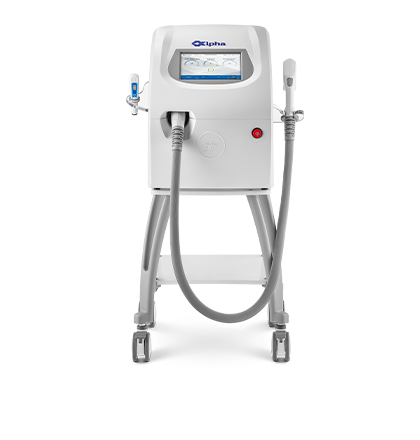
Safer-Practice Settings and Protocols (Principles, Not Parameters)
Exact fluences, densities and pulse settings belong in the device IFU (Instructions for Use) and in hands-on training, and they vary by platform, indication and individual patient. What does generalise is the set of principles that reduce risk.
Published guidance for energy-based treatment in darker skin consistently points to longer wavelengths, the minimum effective fluence, lower density, fewer passes, appropriate cooling and longer intervals between sessions.
In practice, that means starting conservatively and building gradually rather than chasing a result in a single aggressive session. A test patch in a representative but discreet area is good practice in higher Fitzpatrick types. Reviewed after an appropriate interval before you commit to a full treatment, it helps you read how an individual’s skin responds.
Allow generous healing time between sessions, keep cooling consistent throughout treatment, and document settings and results so each session informs the next. Treat to a conservative clinical endpoint rather than the most visible immediate reaction, and stop sooner rather than later if the skin response exceeds what you expected. When the device IFU and your training conflict with what feels commercially tempting, follow the IFU.
Reducing the Risk of PIH Before and After Treatment
Much of the work that prevents PIH happens around the treatment rather than during it. Before treatment, strict photoprotection is non-negotiable: broad-spectrum, high-SPF sunscreen, ideally with iron oxides for additional visible-light protection. The patient should also avoid treatment if their skin has recently tanned, since prior sun exposure and epidermal disruption both worsen PIH risk.
Where clinically appropriate and under the relevant prescriber’s direction, priming the skin with topical agents such as retinoids or depigmenting preparations may help. This is a decision for the treating clinician within prescribing rules rather than a blanket recommendation.
Afterwards, gentle aftercare, continued cooling and disciplined sun avoidance support recovery and limit reactive pigmentation. Expectation-setting is part of risk management, too. Outcomes in darker skin are often achieved over a course of treatments rather than in one. Improvement is gradual, and conditions such as melasma are prone to recurrence and are typically managed alongside topical therapy. Framing the goal as a visible improvement, maintained over time, rather than a one-off “fix”, protects both the patient and the clinic.
When to Proceed With Caution or Refer
Some presentations call for a pause. A history of keloid or hypertrophic scarring, a recent tan, recent isotretinoin use, active or unstable inflammatory skin disease, photosensitising medication, or unrealistic expectations should all prompt a more cautious plan or a deferral.
Any pigmented lesion where the diagnosis is not clear belongs with a dermatologist before any energy is applied, not in a cosmetic treatment chair. The most experienced practitioners are comfortable saying “not today” or “not with this device”, and that conservative judgement is itself a marker of a high-standard clinic.
Building Confidence in Your Team
Safe, confident treatment of darker skin is a capability you build, not a setting you select. It comes from understanding the science, knowing your device’s IFU thoroughly, and having protocols and patient-selection guidance you can rely on. This is where the right supplier relationship earns its keep.
We support partner clinics with hands-on training, treatment protocols and patient-selection guidance, backed by a clinical and KOL (Key Opinion Leader) network. This is so your team can offer treatments across diverse skin types with genuine confidence rather than caution born of uncertainty. Investing in that knowledge is what turns a capable device into a reliably safe service.
Talk to AMP About Treating Diverse Skin Types
If you are selecting or expanding energy-based capability and want it to serve every patient safely, we can help you match the right device and training to your clinic. Explore the full medical aesthetic device range, or get in touch to discuss device selection and training for Fitzpatrick IV to VI.
FAQs
Is laser treatment safe for darker skin types?
Yes, when the device, wavelength, settings and protocol are chosen appropriately. Modern non-ablative and longer-wavelength technologies have a well-established safety record in Fitzpatrick IV to VI, but darker skin carries a higher risk of post-inflammatory hyperpigmentation, so conservative settings, careful patient selection and proper cooling are essential. Exact parameters should always follow the device instructions for use and accredited training.
Which wavelengths are safer for darker skin?
As a general principle, longer wavelengths are safer because they penetrate more deeply and are less absorbed by melanin in the epidermis. The 1064nm Nd:YAG is widely considered the gold standard for hair removal in darker skin, and non-ablative fractional wavelengths such as 1550nm and 1927nm have a strong evidence base for resurfacing and pigmentation when used at conservative energy and density.
How can clinics reduce the risk of PIH in darker skin?
Before treatment, use strict photoprotection and avoid treating recently tanned skin. During treatment, favour longer wavelengths, the minimum effective fluence, lower density, fewer passes and consistent cooling, with longer intervals between sessions. Afterwards, support recovery with gentle aftercare and sun avoidance. A test patch in higher Fitzpatrick types helps gauge individual response before a full treatment.
Can IPL be used on Fitzpatrick IV to VI?
IPL requires the most caution of any light-based modality in darker skin because its broad spectrum is strongly absorbed by epidermal melanin, raising the risk of burns and pigmentary change. It can have a role in carefully selected patients when delivered with appropriate filtering, robust cooling and conservative settings, with the greatest care as skin type increases towards VI. Rigorous patient selection and the device instructions for use should always guide the decision.
What should practitioners assess before treating darker skin?
Start with Fitzpatrick type, but go further: assess constitutive pigment objectively where possible, take a history of PIH and keloid or hypertrophic scarring, check for recent sun exposure or tanning, review photosensitising medication, and understand previous treatment responses. Set realistic expectations about staged treatment and recurrence, and refer any pigmented lesion of uncertain diagnosis for dermatological review before treatment.