Put an Alpha specification sheet next to a Soprano Titanium brochure and, at first glance, you’re comparing two professional diode hair removal systems built for busy clinics.
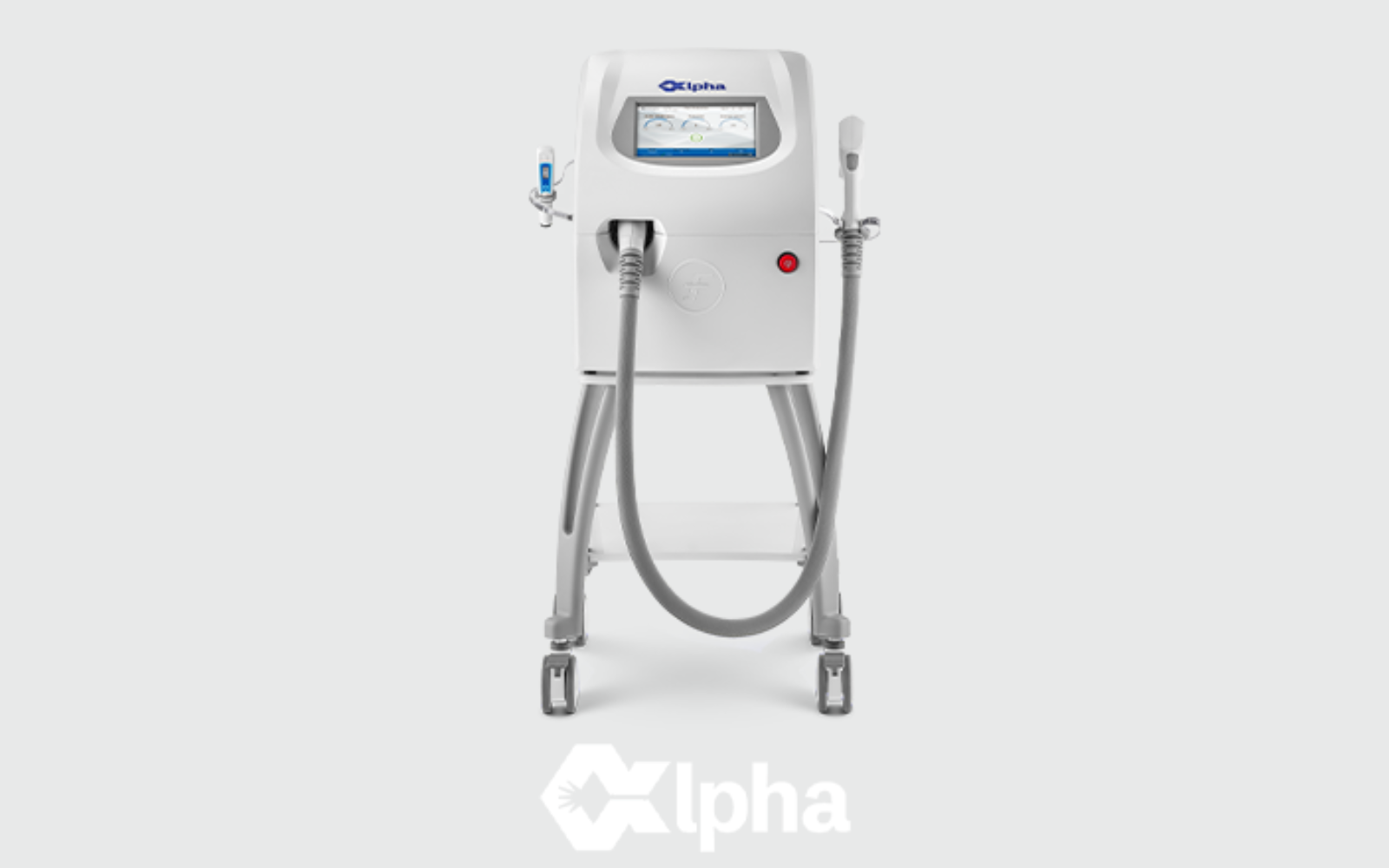
Look closer, and they’re quite different purchases. Alpha is a dual-technology system from FormaTK Systems, supplied in the UK by us. Hair removal is handled by the XLP Diode Laser, an 808 nm Extended Long Pulse system with two applicators: the 1.2 cm² ALD (Advanced Laser Diode) and the 4.5 cm² LLD (Large Laser Diode). Both run five treatment modes, including PowerMotion for high-fluence single-pass delivery, FineMotion for the fine, miniaturised hairs that remain later in a course, and SafeTone for melanin-rich skin. The same workstation carries a 3D IPL system, which extends the platform into selected pigmentation, vascular concerns, acne and skin rejuvenation, with more than 20 clinical applications across the complete system.
For a clinic owner, that changes the question from “which diode has the better specification?” to something more practical: what work will this machine actually do once it’s taking up space in a treatment room? It’s the main issue if you’re weighing up professional laser hair removal devices for a clinic that does more than hair removal.
Why Soprano Became the Default Name
Soprano earned its position. Alma built the range around SHR, in-motion delivery and strong contact cooling, then developed it through several generations, and in SHR In-Motion mode the practitioner repeatedly moves the applicator across the area, building heat gradually while contact cooling manages skin temperature. That counted commercially too, since comfort became something clinics could actively promote instead of just manage.
The current Soprano Titanium Special Edition combines 755 nm, 810 nm and 1064 nm wavelengths in a single simultaneous emission. ICE Plus provides continuous contact cooling, while the 4 cm² Trio MAX applicator is designed for larger treatment areas. Add years of brand recognition, and this isn’t an attempt to prove the familiar machine is obsolete.
The question is what Alpha does differently, and which Soprano you’re actually comparing it against.
Which Soprano Are You Actually Comparing Against?
“Soprano” is a family, not a single machine, and the differences between generations are big enough to change the comparison.
The original Soprano ICE is now well over a decade old. It delivers its three wavelengths through three separate applicators, one each for 755 nm, 810 nm and 1064 nm, each with a 1 cm² spot size, so the practitioner selects an applicator to suit the patient rather than treating with all three at once. Plenty of UK clinics still run one every day.
The Soprano ICE Platinum changed that by combining all three wavelengths in a single 2 cm² Trio applicator, firing them simultaneously. The Soprano Titanium kept the same triple-wavelength approach and roughly doubled the applicator again to 4 cm². Throughout this article, Soprano means the current Soprano Titanium, because that is the machine Alma sells today and the one a new purchase competes with.
The older models come into it if your clinic already owns one. Against an installed ICE or ICE Platinum, Alpha isn’t a sideways move between similar diodes: the 4.5 cm² applicator is a different working speed to a 1 cm² or 2 cm² handpiece, PowerMotion replaces applicator-swapping with continuous in-motion delivery, and the 3D IPL side adds a treatment menu no Soprano offers at any tier.

Alpha vs Soprano at a Glance
Technology and Wavelengths
Soprano has the more varied laser architecture. The Titanium platform combines 755 nm, 810 nm and 1064 nm wavelengths simultaneously. Alma positions the 755 nm component towards shallower targets and finer hair. It positions 810 nm as the central diode wavelength and 1064 nm as the deeper-penetrating component with lower melanin absorption.
For a clinic buying just for hair removal, that wavelength range is a strong part of Soprano’s case. However, the machine adjusts the wavelength distribution according to the Fitzpatrick skin type entered by the operator. For example, all three wavelengths are always fired, and the output is spread across the selected energy; a total output of 15 J may be 5 J of 755 nm, 5 J of 1064 nm and 5 J of 810 nm or other combinations depending on skin type. This may help explain reports of miniaturised hair during Soprano treatment courses, as potentially certain depths may not be getting a full therapeutic dose.
Alpha sticks with 808 nm and changes what the diode does with it. XLP stands for Extended Long Pulse. The pulse is shaped to diffuse heat evenly along the follicle so the bulge, matrix and dermal papilla reach the destruction threshold, which FormaTK puts at roughly 70°C held for 1 ms at the papilla, while Golden Touch Adaptive Cooling protects the epidermis. Alpha then offers five treatment modes around that 808 nm platform.
Single Mode delivers the selected energy in one pulse, for lighter skin with higher tolerance. PowerMotion delivers high-fluence pulses in one continuous pass. Fast Mode is a low-energy in-motion option, up to 10 J/cm² at up to 10 Hz, for cumulative heating, where that suits the patient, similar to the low-fluence in-motion approach used by Soprano. FineMotion builds heat around more superficial follicles, including miniaturised and vellus hairs. SafeTone heats gradually to protect the epidermis on melanin-rich skin and the darkest skin tones.
Soprano puts more wavelengths into its hair removal applicator but uses lower energies. Alpha uses one, gives the practitioner more ways to deliver it, then adds a separate IPL system on the same workstation.
Treatment Speed and Coverage
Soprano Titanium Special Edition has a 4 cm² Trio MAX applicator, with Alma publishing an improvement of up to 20% in treatment speed under specified conditions compared with its earlier configuration.
Alpha’s larger LLD applicator is 4.5 cm², and PowerMotion covers each area in one pass rather than several. FormaTK quotes up to three times faster treatments, and around five times faster than a traditional stamping technique over the same area. Those are manufacturer figures against manufacturer-chosen baselines.
Those figures can’t be used to determine a direct winner because manufacturers use different benchmarks and there is no controlled Alpha-versus-Soprano speed trial. If throughput matters, demo both machines and time the treatments that dominate your diary. Full legs and backs will tell you more than unrelated brochure percentages.
Skin Type Range
Soprano Titanium includes 1064 nm, which has lower epidermal melanin absorption than shorter hair removal wavelengths and is particularly relevant when treating darker skin. Alma positions the system for Fitzpatrick I to VI.
Alpha is also designed for Fitzpatrick I to VI and approaches darker skin from three directions rather than through a wavelength. SafeTone is a dedicated mode that heats the follicle gradually to protect the epidermis on melanin-rich skin and the darkest skin tones. Golden Touch Adaptive Cooling adjusts contact temperature during the treatment. And the Milo Melanin Meter measures melanin at each treatment spot rather than once per patient, so parameters follow the reading instead of a Fitzpatrick estimate. That helps where several practitioners share the same machine, and where a patient’s tone varies across treatment areas.
Our guide to device and wavelength selection for Fitzpatrick IV to VI explains why wavelength is only part of the decision. Cooling, pulse characteristics, fluence, patient selection and practitioner judgement matter too.
For clinics treating a large proportion of Fitzpatrick IV to VI patients, Soprano’s 1064 nm component deserves serious weight. Alpha’s case rests on SafeTone, adaptive cooling, per-spot melanin guidance and the AlphaLine data across Fitzpatrick I to VI.
Comfort and Patient Experience
Soprano made comfort part of its identity early on. SHR builds heat progressively. The practitioner keeps the applicator moving over the area for repeated passes at lower fluence, and ICE Plus cools the skin while the temperature climbs. Patient comfort has also been a significant part of Soprano’s commercial appeal.
The cost of that approach is the passes themselves. Heat has to accumulate over several sweeps before the follicle reaches coagulation, so the result depends on the practitioner covering the area evenly for long enough, and a patch that gets fewer passes gets less energy. It also means more pulses per treatment. In FormaTK’s own comparison of delivery methods, low-fluence in-motion treatment needs multiple pulses to reach coagulation and consumes more pulses per session, which the manufacturer links to shorter applicator life.
PowerMotion takes the opposite route. FormaTK describes it as the first high-fluence in-motion technique. Each pulse carries enough energy to coagulate the follicle while the applicator continues moving, allowing the area to be covered in one pass rather than building heat over several. Alpha also keeps the low-fluence Fast Mode for patients who better tolerate the gradual heating, so the choice is made per patient rather than fixed by the machine.
On comfort itself, we wouldn’t claim one is inherently more comfortable. There isn’t a head-to-head study, and patient experience changes with hair density, area, parameters, skin type and operator technique. Alpha’s answer is Golden Touch Adaptive Cooling, which adjusts contact temperature through the treatment via an 18-karat gold-plated sapphire tip. This is better judged during a live demo.

Fine and Miniaturised Hair
Every hair removal course ends up dealing with fine, miniaturised hair. Terminal hairs respond first; what remains by session five or six is thinner and paler, with less pigment available to absorb the energy, which means less heat reaches the follicle. The AlphaLine data quantifies it: by session five, around 80.5% of remaining hairs were classified as fine, and by session six, approximately 94.76%.
Low-fluence multi-pass delivery is at its weakest here. FormaTK’s published comparison lists higher vellus regrowth as a trade-off of the low-fluence in-motion approach, the reasoning being that a fine hair needs each pulse to count rather than relying on heat accumulating over repeated sweeps.
Alma’s answer to finer hair is a wavelength, with the 755 nm component of the Titanium positioned towards shallower targets. Alpha’s answer is a mode built for it. FineMotion is a controlled multi-pulse technique that builds heat at superficial follicle level, developed from the AlphaLine findings specifically for fine, miniaturised and vellus hair.
Neither approach has been tested against the other later in a course. What a clinic can check at a demo is whether the machine has a protocol for session six, not just session one.
Evidence
Soprano’s SHR technique has been studied in peer-reviewed trials since 2009, and its triple-wavelength systems have a growing body of published clinical data.
Alpha’s evidence is newer, but the AlphaLine France Project is notable for its scale. The observational project reports on 45,467 patients, approximately 200,000 sessions, and 338 clinics over around four years. Patients across Fitzpatrick I to VI are represented, and zero serious adverse events were reported within the dataset.
It also tracked how remaining hair changed as courses progressed. The fine-hair figures in the previous section come from that tracking, and FineMotion was developed in response to them.
AlphaLine isn’t a head-to-head Alpha-versus-Soprano trial and shouldn’t be presented as proof of superiority. Its value is that it reflects routine use across hundreds of working clinics.
Treatment Range
This is the point where the two systems stop being close substitutes. Soprano Titanium is built around hair removal. Alpha’s diode is only half of the platform. The 3D IPL side offers five applicators across two spot sizes: three 2 cm² 3D IPL S applicators at 430, 530 and 590 nm, and two 5 cm² 3D IPL L applicators at 530 and 650 nm. Wavelength, energy, pulse duration and contact cooling temperature can be independently controlled, with cooling selectable at 5, 10, 15 or 20°C. That cooling control is what the “3D” refers to.
FormaTK’s argument is that overcooling constricts vessels in vascular work and drops the core temperature of pigment in pigmentation work, both of which force higher fluences, so being able to dial cooling back lets the end point be reached at lower energy. In practice, that covers selected pigmentation, vascular concerns, acne and post-acne erythema, and the Tight & Bright skin rejuvenation treatment.
For a dedicated hair removal clinic, that extra capability may add little. For a mixed aesthetics clinic, a single device that can perform both hair removal and IPL work may earn its treatment-room footprint more quickly.
We have also reviewed early evidence involving Alpha Pro 3D IPL for rosacea and facial telangiectasia. The case series is small and shouldn’t carry the same evidential weight as AlphaLine, but it demonstrates the additional work the IPL side is intended to cover.
Furthermore, Alpha’s S530 applicator can also deliver pulses at 9 Hz in its Tight & Bright treatment. This builds heat in the dermis to stimulate collagen while treating red and brown pigmentation, so the treatment addresses tone and texture in one session, similar to Sciton’s BBL.
Running Costs
Machine price alone doesn’t tell you enough. Compare the complete configuration, warranty, service cover, applicator replacement costs, consumables, training and what happens if the device is unavailable for a few days.
Then compare what each device lets one treatment room sell. A clinic running Soprano Titanium has a hair removal room. A clinic running Alpha has a room that covers the same hair removal diary and can also book pigmentation, vascular and skin rejuvenation work through the 3D IPL side. Getting that second treatment menu alongside a Soprano means a second device: a second purchase, a second service contract, a second training pathway and, in many clinics, a second room.
If you already own a capable IPL system, or your diary is full of hair removal, Alpha’s second platform may add little and Soprano’s dedicated architecture is the cleaner buy. The dual-platform argument is strongest for a mixed clinic that currently refers IPL work elsewhere or is considering two separate purchases to build out its treatment menu. For that clinic, the question isn’t which machine costs less. It’s which machine leaves less of the diary empty.
Training, Service and UK Support
A working laser needs more than good specifications. Someone needs to train practitioners, answer clinical queries, and deal with technical issues.
Alma has an established support structure for Soprano systems purchased through authorised providers, alongside treatment protocols and recommended settings.
Alpha is supplied in the UK by us, with device training plus ongoing clinical and technical support.
Ask who delivers training, whether additional staff can be trained later, what service cover includes and who the clinic calls when a problem appears halfway through a booked day. That’s when support stops being a line on a quote.
Which One Fits Your Clinic?
If hair removal is the centre of your business, Soprano Titanium makes a strong case. Its triple-wavelength architecture, established brand and longer clinical literature all count in its favour, especially if you have little need for IPL.
For a mixed aesthetics clinic, Alpha becomes more interesting. Hair removal sits alongside pigmentation, vascular and skin rejuvenation treatments, giving the same device more ways to earn its space.
Clinics treating a large proportion of Fitzpatrick IV to VI patients should examine the darker-skin protocols closely. Soprano’s 1064 nm component is significant, while Alpha combines SafeTone, adaptive cooling and per-spot Milo melanin readings, backed by AlphaLine data across Fitzpatrick I to VI.
Milo may also be useful where several practitioners share the same machine. Soprano supports consistency through established protocols and recommended settings, while Alpha adds a skin measurement that can inform parameter selection.
If you’re upgrading from an older Soprano ICE or ICE Platinum, the calculation is different again. You’re not comparing like-for-like machines. Applicator size, delivery method and treatment range all change, while Alpha’s 3D IPL platform adds treatments that aren’t available on Soprano. The range section above covers what that difference looks like in practice.
If price is driving the decision, look beyond the purchase figure. Run the numbers against realistic utilisation, service costs, treatment mix and the support attached to the device.

Frequently Asked Questions
What is the difference between the Alpha laser and Soprano?
Soprano Titanium Special Edition is a dedicated laser hair removal platform combining 755 nm, 810 nm and 1064 nm wavelengths simultaneously, delivered with SHR in-motion passes that build heat gradually at low fluences. Alpha uses an 808 nm XLP diode laser with five treatment modes, including high-fluence single-pass PowerMotion, FineMotion for fine hair and SafeTone for darker skin, and pairs it with 3D IPL. The main differences are the wavelength setup, how heat is delivered and the treatment range.
Can the Alpha laser treat darker skin types?
Alpha is designed for use across Fitzpatrick I to VI. It combines 808 nm diode energy with contact cooling, skin-specific protocols and Milo melanin guidance. Patient assessment and correct protocol selection remain essential.
What evidence supports the Alpha laser system?
The AlphaLine France Project reports on 45,467 patients, approximately 200,000 sessions and 338 clinics over around four years. The dataset includes Fitzpatrick I to VI and reports zero serious adverse events.
Is the Alpha laser a good upgrade from a Soprano ICE?
The original Soprano ICE uses separate single-wavelength applicators with a 1 cm² spot size, so moving to Alpha’s 4.5 cm² applicator with in-motion delivery is a significant change in working speed, and the 3D IPL side adds treatments the ICE can’t offer. If you own the newer ICE Platinum, the gap is smaller, but the IPL capability still applies. The comparison is against what your clinic owns now, which is worth raising at a demo.
What does the Alpha laser cost?
Pricing depends on the configuration, applicators and commercial package selected. We offer current pricing on enquiry.
What support does AMP provide with the Alpha laser?
We provide training with the Alpha system plus ongoing clinical and technical support, including help with treatment protocols and practitioner questions.
Does the Alpha laser need multiple passes like SHR?
No. In PowerMotion mode, each high-fluence pulse is designed to coagulate the follicle, so the applicator covers each area in one continuous pass. A low-fluence Fast Mode is available if gradual heating is preferred for a particular patient.
See the Alpha Laser Running
A specification sheet can tell you the wavelengths and spot sizes. It can’t tell you whether your practitioners like the handpiece, how quickly they can work through a full-leg treatment or whether the extra IPL capability will actually earn money in your clinic.
If you’re considering Alpha as a Soprano laser alternative, view the full Alpha Laser System page or contact us to arrange a demonstration.
Soprano, Soprano Titanium, SHR, In-Motion and ICE Plus are trademarks or registered trademarks of Alma. Alma is not affiliated with AMP or the Alpha Laser System. Comparative statements in this article are based on publicly available manufacturer information current at the time of writing. Alpha and associated technology names are products or technologies of FormaTK Systems.