
For UK clinics choosing a diode laser, the real question is rarely whether the technology works in a demo. It is whether it holds up under everyday clinical use, across thousands of patients, hundreds of operators and every skin type that walks through the door. The AlphaLine France Project answers exactly that, and at a scale rarely seen in aesthetic medicine.
Conducted across France in partnership with Keros Technology, the AlphaLine France Project is an ongoing, real-world observational study of the Alpha Laser System and its 808 nm XLP diode laser. Rather than a tightly controlled trial run in a single academic centre, it captures how the platform performs in routine commercial practice, the same conditions a UK clinic works in every day.
| 45,467 | ~200,000 | 338 | 4 |
| Patients | Sessions | Clinics | Years |
One of the Largest Real-World Evidence Bases in Laser Hair Removal
Most published evidence on laser hair removal comes from controlled research in hospitals, universities, or single private clinics. The largest peer-reviewed diode cohorts to date run to roughly 1,000 patients. The AlphaLine France Project documents 45,467 patients and around 200,000 treatment sessions across 338 working commercial clinics, treating ordinary consumer patients in routine practice.
What stands out is not only the volume, but the consistency. Across 338 independent clinics and roughly four years of continuous use, treatment parameters, workflows and biological outcomes proved reproducible to a degree that is unusual in real-world data of this size. For a clinic owner, that reproducibility is the point: it is evidence the platform delivers predictable results in the field, not just in ideal conditions.
The Biological Inflection Point: Why Sessions 4 to 6 Change Everything
The project’s defining finding is that hair removal is not a single, repeated event. It is a biological journey in which the follicle itself transforms.
Sequential analysis showed a clear transition between the fourth and sixth sessions. Residual follicles shift from coarse terminal hairs to fine, miniaturised structures:
- By Session 5, around 80.5% of remaining hairs were classified as fine
- By Session 6, that figure rose to approximately 94.76%
In other words, by the mid-point of a treatment course the target has fundamentally changed. Fine and miniaturised hair holds heat differently to coarse terminal hair, which is why a device that can adapt its delivery, rather than repeat a fixed setting, matters so much in the later stages of a course.
Tellingly, clinicians across the network independently lengthened their treatment intervals over a course, from around 9 weeks early on to roughly 14 weeks in later sessions. Hundreds of clinics converging on the same timing pattern, without being told to, is an independent real-world signature of exactly that follicular shift.
Fewer Sessions, Stronger Clinic Economics
When protocols adapt to the changing follicle, patients finish sooner. In the AlphaLine dataset, treatment courses were completed in approximately 6.68 sessions on average, against a commonly cited industry benchmark of 8 to 10.
That is roughly 25 to 33% fewer visits per patient, and it flows straight to the bottom line:
- Higher clinic throughput and better use of each treatment chair
- Shorter time to completion, which improves patient satisfaction and referrals
- Stronger per-course economics without cutting corners on results
For a clinic weighing up a diode laser purchase, this is the commercial case in one line: the same result in fewer appointments.
A Platform Built to Adapt
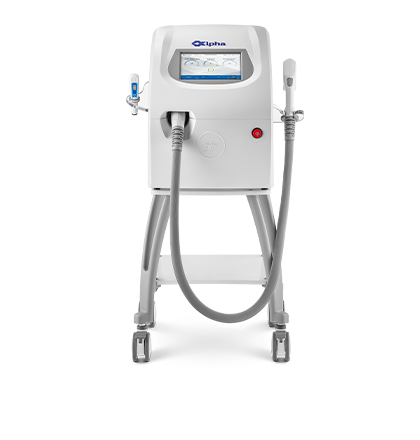
The Alpha Laser System is designed as an ecosystem rather than a single fixed protocol, because no one delivery method suits every patient, body area or stage of treatment. It combines:
- Five treatment modes, each matched to a specific follicular stage, skin type and anatomy: Single Mode and PowerMotion for early, coarse-hair phases; Fast Mode for fast, comfortable in-motion treatment; FineMotion for fine, superficial and miniaturised hair in the later stages; and SafeTone for safe, effective treatment on darker skin types
- XLP Golden Touch cooling, a sapphire and 18-karat gold-plated handpiece with an adaptive cooling algorithm that continuously balances patient comfort against clinical effect, protecting the epidermis across long sessions
- MILO objective melanin assessment, which uses diffuse reflectance spectroscopy to measure epidermal melanin and support individualised, safer parameter selection across diverse skin types
- 3D IPL technology integrated into the same platform
Notably, FineMotion was developed directly out of the AlphaLine findings, purpose-built for the fine-hair challenge the data revealed in the later stages of a course.
Safety and Durability at Commercial Scale
Evidence at this scale also speaks to safety and build quality, two things that matter enormously when a device is treating patients day in, day out:
- Zero serious adverse events were reported across approximately 200,000 sessions, spanning the full Fitzpatrick I-VI range and both genders
- 152 of the 338 clinics (around 45%) had been running the Alpha System for 18 or more months of continuous use at the time of analysis
In a category where capital equipment is often rotated out or shelved, nearly half the installed base staying in daily service for 18 months and beyond is a strong real-world signal of clinical confidence, workflow fit and engineering reliability.
A Broad, Real-World Patient Mix
The findings reflect a genuine cross-section of aesthetic practice rather than a narrow study cohort. Treatment spanned the full Fitzpatrick I-VI spectrum, with types V and VI making up around 9% of patients, treated successfully on the same platform with parameters guided by MILO melanin readings and SafeTone where appropriate. Around 65% of sessions fell in the core 20 to 40 age bracket, and treatment covered the full anatomical map: face, beard, neck, armpits, chest, back, abdomen, bikini, buttocks, hands and legs.
One figure worth flagging for UK clinics is the gender split: approximately 93% female to 7% male. Male laser hair removal is among the fastest-growing segments in aesthetics, and it is dominated by exactly the dense, coarse terminal hair the Alpha System’s modes are engineered to handle. For clinics, that 7% points less to a technology gap and more to an open commercial opportunity in marketing and positioning.
Support That Goes Beyond the Equipment
Aesthetic Medical Partnership is the UK distributor of the Alpha Laser System. As with every device in our range, our role does not end at supply. We work alongside clinics with training, marketing support and ongoing clinical guidance, so new treatments are introduced with confidence and start earning quickly.
Evidence like the AlphaLine France Project is a large part of why we partner with the platforms we do. It gives UK clinic owners something firmer than a specification sheet: proof, at real scale, that the technology performs, stays safe across skin types and keeps delivering over years of commercial use.
Why Aesthetic Medical Partnership?
We bring together evidence-based technologies and in-clinic support to help you build treatment protocols tailored for the modern aesthetic patient. By working with AMP, clinics gain not just a supplier, but a committed partner in long-term growth.
Join the movement.
Partner with us today to transform your practice and elevate your patient outcomes.
Enquire about the Alpha Laser System