
For many UK practitioners, ‘Fraxel’ has become the default term for fractional resurfacing.
Developed by Solta Medical (now part of Bausch Health), the Fraxel Dual set the benchmark for non-ablative dual-wavelength treatment when it launched over a decade ago.
It remains a trusted, widely recognised platform in clinics around the world.
But the device landscape has changed. Clinic economics are tighter, and patient expectations are higher. A growing number of practitioners require a resurfacing solution that aligns with modern workflows without the overhead of a legacy console system. That is the gap MultiFrax was built to fill.
This article presents a straightforward comparison of MultiFrax and Fraxel Dual across the key areas that matter most to clinic owners and practitioners: wavelength capability, portability, cost of ownership, clinical flexibility, and day-to-day usability.
The Shared Foundation: 1550nm and 1927nm
Both devices are built around the same dual-wavelength principle that has become the gold standard in non-ablative fractional resurfacing.
The 1550nm erbium fibre wavelength penetrates deeper into the dermis, addressing textural issues such as acne scars, fine lines, wrinkles, stretch marks, and overall skin laxity. The 1927nm thulium wavelength works more superficially, targeting pigmentation, sun damage, dyschromia, and early melasma.
Published clinical evidence supports the use of both wavelengths in combination for more complete results than either wavelength alone. A multi-centre study published in the Journal of Drugs in Dermatology demonstrated moderate improvement in photodamage severity with combined 1550/1927nm treatment, alongside excellent tolerability and no major adverse events.
In this respect, MultiFrax and the Fraxel Dual operate on the same proven clinical foundation. The differences lie in how each platform delivers those wavelengths, and what that means for your clinic.
Where MultiFrax Differs from the Fraxel Dual
Simultaneous Dual-Wavelength Delivery
The Fraxel Dual allows practitioners to choose either the 1550nm or 1927nm wavelength per pass, switching between them during a session. MultiFrax takes this a step further with its patented SimulScan technology, which fires both wavelengths simultaneously in a single pass. This allows practitioners to address both deep textural issues and surface pigmentation at the same time. This eliminates the need for repeated sequential passes over the treatment area.
The clinical advantage is efficiency: fewer passes, shorter treatment times, and a lower cumulative thermal load on surrounding tissue. For patients, this can lead to improved comfort and a streamlined session. For clinics, this means the ability to treat more patients each day.
True Portability
The Fraxel Dual is a console-based system. It requires a dedicated room, a power outlet, and a fibre-optic cable connecting the base unit to the handpiece. This is the standard form factor for most fractional lasers on the market.
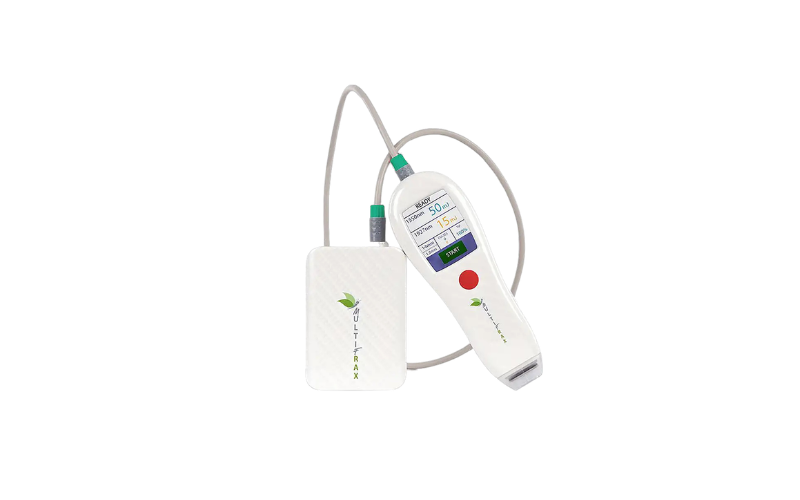
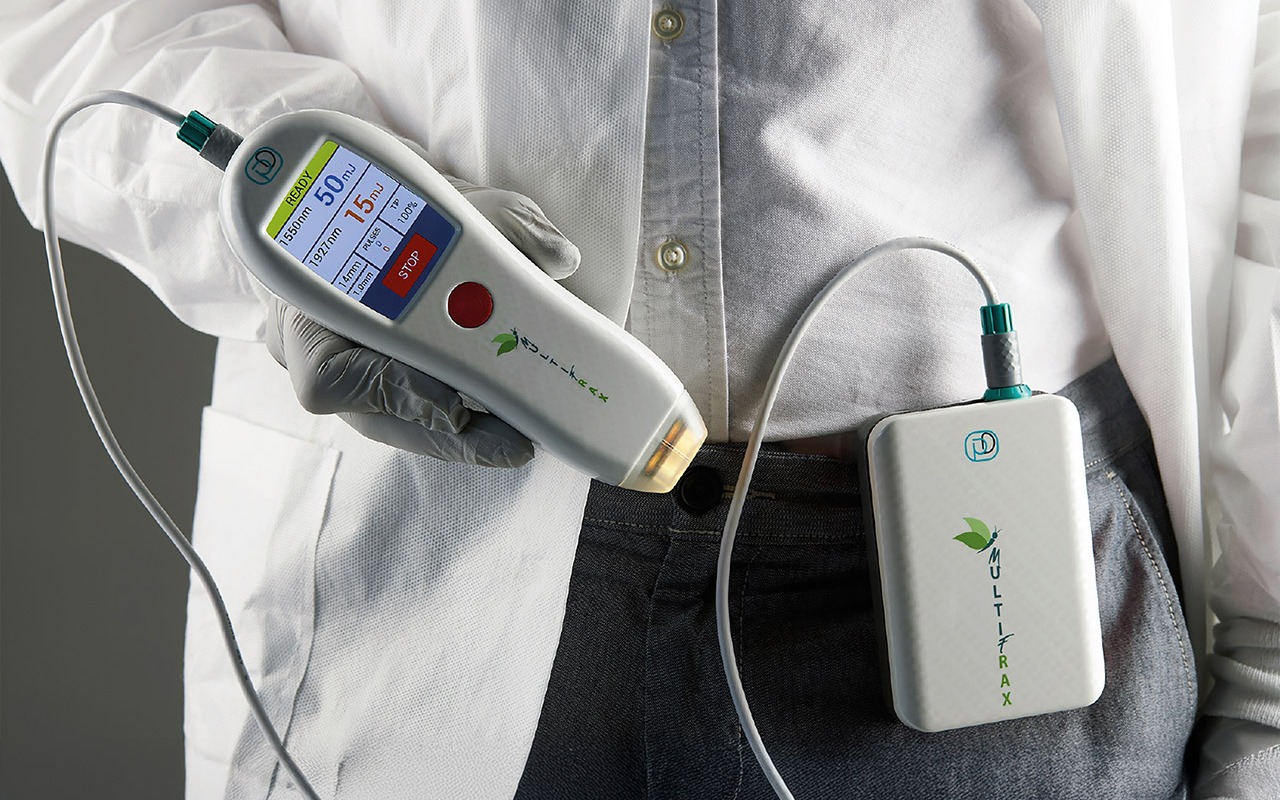
MultiFrax reimagines this completely. The laser source sits inside a lightweight handpiece powered by a rechargeable lithium battery that provides over four hours of continuous use.
There is no console, no wall cable, and no fibre-optic delivery system. Practitioners clip in the battery, attach the handpiece, and are treatment-ready in seconds in any room, at any location.
This portability also provides a technical benefit. Because the laser source is placed within millimetres of the skin rather than metres away via a fibre-optic connection, the beam arrives with less dispersion. The result is a finer, more precise 150μm micro-column, which can contribute to improved comfort during treatment and more controlled thermal zones.
Cost of Ownership and Per-Treatment Economics
This is where the comparison becomes particularly compelling for clinic owners. Traditional console-based fractional lasers, such as the Fraxel Dual, have considerable costs. These can include expensive initial purchase or lease prices, continuous service contracts, consumable tips, and the overhead involved with dedicating a room to a large device.
MultiFrax offers up to 90% lower cost per use than competing platforms. Each multi-treatment tip delivers approximately two million shots, which is enough for seven full-face treatments, five décolletage sessions, and ten hand treatments.
The device requires no external cooling system, no fibre-optic replacements, and no annual calibration. For clinics wanting to offer fractional resurfacing without the financial burden of a traditional system, the economics are significantly more favourable.
Precision and Operator Guidance
The Fraxel Dual uses an intelligent optical tracking system that adjusts pulse delivery to hand speed, distributing treatment zones evenly across the skin. It is a successful approach that has helped standardise treatment quality for years.
MultiFrax offers a comparable level of treatment control through its SmartSense™ real-time feedback system, which visually signals the operator when handpiece speed and contact quality are optimal. The device also provides adjustable scan widths (2-14mm) and flexible micro-column spacing (0.5-2mm), allowing practitioners to tailor treatment density precisely to each patient’s phototype and clinical indication.
Learn More About the MultiFrax DeviceWhat About the Fraxel FTX?
In April 2025, Bausch Health launched the Fraxel FTX, the next-generation successor to the Fraxel Dual. It provides genuine improvements to the Fraxel Dual:
- A handpiece with a 20% reduction in weight and size, and integrated cooling.
- An updated AccuTRAC tracking system.
- A modernised console interface.
The FTX remains a console-based system that requires a dedicated room, fibre-optic delivery, and the associated infrastructure. There is no indication that FTX has implemented simultaneous dual-wavelength firing.
This is the main distinction. The FTX is a refinement of the existing Fraxel model. Where the FTX has made the console experience better, MultiFrax has removed the console entirely.
The Fraxel FTX is a strong device from a reputable brand. But for practitioners whose priorities centre on portability, treatment efficiency, and reduced operating costs, MultiFrax offers a unique set of advantages that the FTX update does not address.
Who Should Consider MultiFrax?
MultiFrax is designed for practitioners and clinic owners who want the clinical capability of a premium fractional resurfacing system without the traditional barriers to entry.
It is particularly ideal for:
- Clinics that want to add fractional laser resurfacing to their menu without the need for a large console and dedicated room.
- Practitioners who want to treat across multiple locations and need a system that travels with them.
- Established laser clinics seeking to lower their cost per treatment while maintaining or improving clinical results.
- Clinics seeking a long-term investment in a growing device category.
It is not a matter of whether the Fraxel Dual is a good device. It is.
It has an excellent clinical track record and strong brand recognition with patients.
The question is whether, in 2026, the traditional console model remains the best option for your specific clinic environment, patient base, and growth plans.
Discover the MultiFrax DeviceThe Bottom Line
The Fraxel Dual has established a reputation as a category-defining device. It introduced millions of patients and practitioners to the benefits of dual-wavelength non-ablative resurfacing, and it remains a respected name in the field.
MultiFrax is built on the same proven wavelength foundation, but delivers it in a fundamentally different way. It is portable, fires both wavelengths simultaneously, costs significantly less to run, and is designed for the way modern clinics actually work.
It offers the clinical depth of a full-sized system with the flexibility, accessibility, and economics that today’s practitioners increasingly demand.
For UK clinics considering fractional resurfacing, whether for the first time or as a replacement for an existing platform, MultiFrax represents a compelling alternative worth serious consideration.
Ready to See MultiFrax in Action?
Book a hands-on demonstration with the AMP team. Fill out a contact form or call 01727 482 432 to arrange your demo.
Get in Touch