
For clinics investing in fractional laser technology, wavelength choice directly shapes results, patient satisfaction, and treatment versatility.
The key point is this: most real-world patients need more than one “type” of correction. Uneven tone and pigmentation are often accompanied by texture issues. Acne scarring commonly comes with post-inflammatory colour change. Photoageing typically shows as a combination of dullness, pigment, and early lines.
That is exactly why MultiFrax stands out. It provides both 1550nm and 1927nm in a single platform, and you can use each wavelength individually or together, depending on the indication and the patient.
What Is MultiFrax?
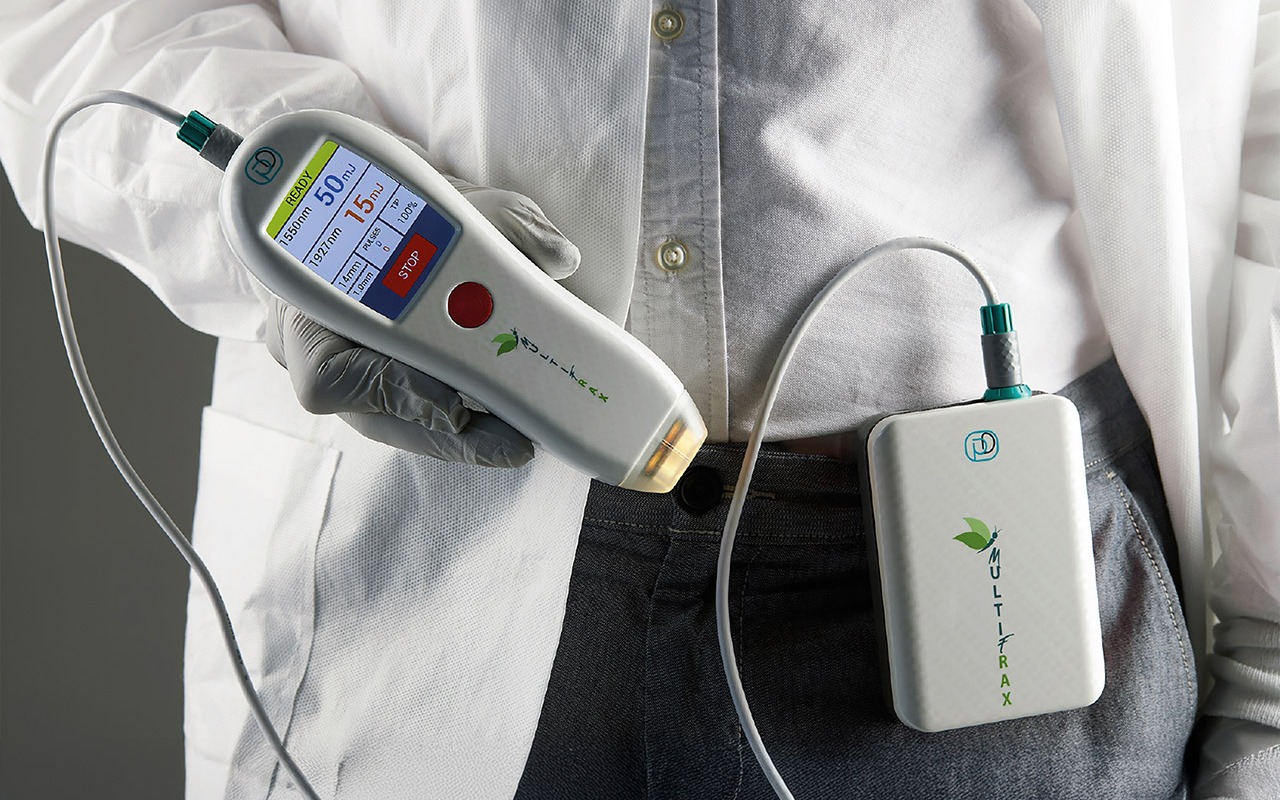
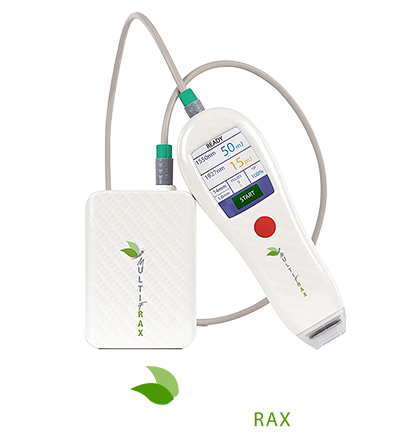
MultiFrax is a dual-wavelength, non-ablative fractional laser device that combines 1550nm erbium glass and 1927nm thulium into a single system.
Its SimulScan™ technology allows operators to treat texture, pigmentation, scarring, and sun damage in a single pass by firing 1550nm and 1927nm wavelengths either individually or simultaneously. That means fewer compromises when patients present with mixed concerns, and clearer treatment pathways when you want to sequence results across a course.
MultiFrax is delivered via a handheld applicator, giving practitioners precise control over placement and coverage across different facial zones. In day-to-day clinic use, the portable format allows a smoother workflow, easier access around contours (such as the perioral area and peri-orbital region), and more consistent patterning when treating larger areas.
It’s the ideal device for clinics that value flexibility and long-term ROI.
The Three Ways Clinics Use Dual Wavelength Fractional Laser
While every protocol should be tailored to the specific needs of each patient, MultiFrax provides clinics with three practical options that correspond to how patients present.
Option 1: 1550nm Only for Deeper Texture and Dermal Remodelling
Choose 1550nm when the main goal is collagen remodelling, scar revision, or structural textural change.
Option 2: 1927nm Only for Superficial Tone and Pigment
When brightness, clarity, and dyschromia correction are the major goals, 1927nm is the best choice for superficial delivery.
Option 3: SimulScan™ to Treat Mixed Concerns in a Single Pass
When clinically suitable, combine both wavelengths, especially for patients who want improvement in texture and tone within the same visit. This helps them avoid splitting their plan across different devices or separate treatment types.
This is the main clinical and commercial advantage: you can treat more thoroughly, without forcing patients into a compromised plan that addresses only one layer of the problem.
What 1550nm Contributes
The 1550nm erbium glass wavelength penetrates deeper into the dermis, resulting in controlled columns of thermal coagulation while leaving the epidermis intact.
This makes it especially useful for concerns that require dermal collagen activation and architectural change rather than just surface correction.
Clinically, 1550nm is typically used for:
- Acne scarring
- Fine lines and wrinkles
- Textural irregularities
- Surgical and traumatic scars
- General skin ageing, where firmness and structure are the priority
Because it works deeper, 1550nm triggers a strong wound-healing response, driving neocollagenesis over time. Patients often see progressive improvements across weeks to months, which suits clinics offering course-based treatment plans rather than one-off sessions.
Downtime is usually minimal. Erythema and oedema are expected, and patients should be advised accordingly.
What 1927nm Contributes
The 1927nm thulium wavelength is more strongly absorbed by water, resulting in a shallower penetration profile that concentrates energy in the epidermis and superficial dermis. This makes it particularly well-suited to pigmentary and tone-related concerns.
Clinics most often use 1927nm when treating:
- Sun damage
- Lentigines and dyschromia
- Melasma
- Uneven skin tone
- Superficial photoageing
Importantly, fractional 1927nm thulium has published clinical evidence supporting its use in melasma and photoageing, with studies showing improvement in pigmentation and overall skin quality when appropriate parameters and patient selection are used.
Downtime is often lighter compared with deeper fractional work, but patients should still expect short-term redness and temporary skin roughness.
When Using Both Together Makes the Biggest Difference
In real-world practice, patients rarely present with a single, isolated concern. Texture issues are often associated with pigmentation, acne scarring commonly comes with post-inflammatory colour changes, and photoageing tends to show up as a blend of dull tone, uneven pigment, and early lines.
In these circumstances, it’s limiting to treat the skin as if you have to choose one priority and ignore the rest. This is where dual-wavelength capability becomes genuinely useful in the clinic.
With MultiFrax, clinics can build smarter treatment journeys by sequencing wavelengths across a course, alternating sessions to target different layers, or using SimulScan™ to address multiple issues in a single visit when clinically appropriate.
There is published clinical evidence supporting combined 1550nm and 1927nm fractional approaches as generally well tolerated, with predictable, brief side effects. For clinics, the practical advantage is simple: you can deliver more complete results with fewer compromises, while keeping protocols personalised and results-focused.
Patient Selection and Risk Management
A dual-wavelength platform still requires careful planning, and successful outcomes depend as much on patient selection and risk management as they do on the device itself.
Assess:
- Fitzpatrick skin type
- History of pigmentary issues
- Current sun exposure and photoprotection habits
- Adherence potential and aftercare compliance
- Tolerance for downtime
- Previous inflammatory responses and healing processes
High-Risk Profiles and PIH Prevention
This is especially significant when pigment is part of the treatment goal, because dyschromia issues often overlap with a higher risk profile for post-inflammatory hyperpigmentation.
For higher Fitzpatrick types, or anyone with a history of PIH, a conservative approach is the best option: start with lower settings, consider test spots, extend intervals where needed, and maintain clear communication.
Recovery & Expectations
Pre- and post-treatment photoprotection is required. Patients should also understand that “non-ablative” does not imply “no recovery”. Setting expectations for redness, swelling, and short-term skin roughness helps to ensure satisfaction, while diligent aftercare instructions promote cleaner healing and more predictable outcomes.
Why Clinics Choose MultiFrax
From a business standpoint, MultiFrax solves a common issue for modern aesthetic clinics: expanding clinical capability without increasing device clutter, training burden, or capital spend across multiple platforms.
Instead of having one device that excels at texture and another that targets pigment, MultiFrax combines two proven non-ablative fractional wavelengths in a single platform. That supports a broader indication range while keeping workflows efficient.
The dual wavelength versatility also improves consultations. It makes it easier to explain why a patient’s concern is multi-layered and how you plan to treat it without compromise through:
- faster visible improvement in tone and clarity when appropriate
- progressive structural improvement in texture and scarring over time
- clearer course-based programmes that encourage long-term retention
Handheld Delivery for Consistent, Efficient Treatments
The handheld delivery also plays a role in efficiency. It’s simple for staff to use, comfortable to use across a full clinic list, and helps clinics maintain controlled, repeatable coverage. This becomes key when you’re standardising protocols across multiple practitioners and building course-based programmes.
Final Thoughts
The question is not whether one wavelength is “better” than the other. It is about choosing the best approach for the indication, and acknowledging that most patients benefit from both depth and surface correction across their treatment course.
- 1550nm promotes depth, structure, and collagen remodelling
- 1927nm targets superficial correction, tone, and pigment
- MultiFrax gives clinics the flexibility to use either wavelength individually or to use both together with SimulScan™, when clinically appropriate
If you are considering adding or upgrading fractional laser technology, understanding wavelength behaviour is the first step. Choosing a system that lets you treat mixed concerns without compromise is where strategy meets results.